MISCGrasp: Leveraging Multiple Integrated Scales and Contrastive Learning for Enhanced Volumetric Grasping
1 State Key Laboratory of Multimodal Artificial Intelligence Systems, Institute of Automation, Chinese Academy of Sciences
2 School of Artificial Intelligence, University of Chinese Academy of Sciences
3 Qiyuan Lab † Corresponding author
Method
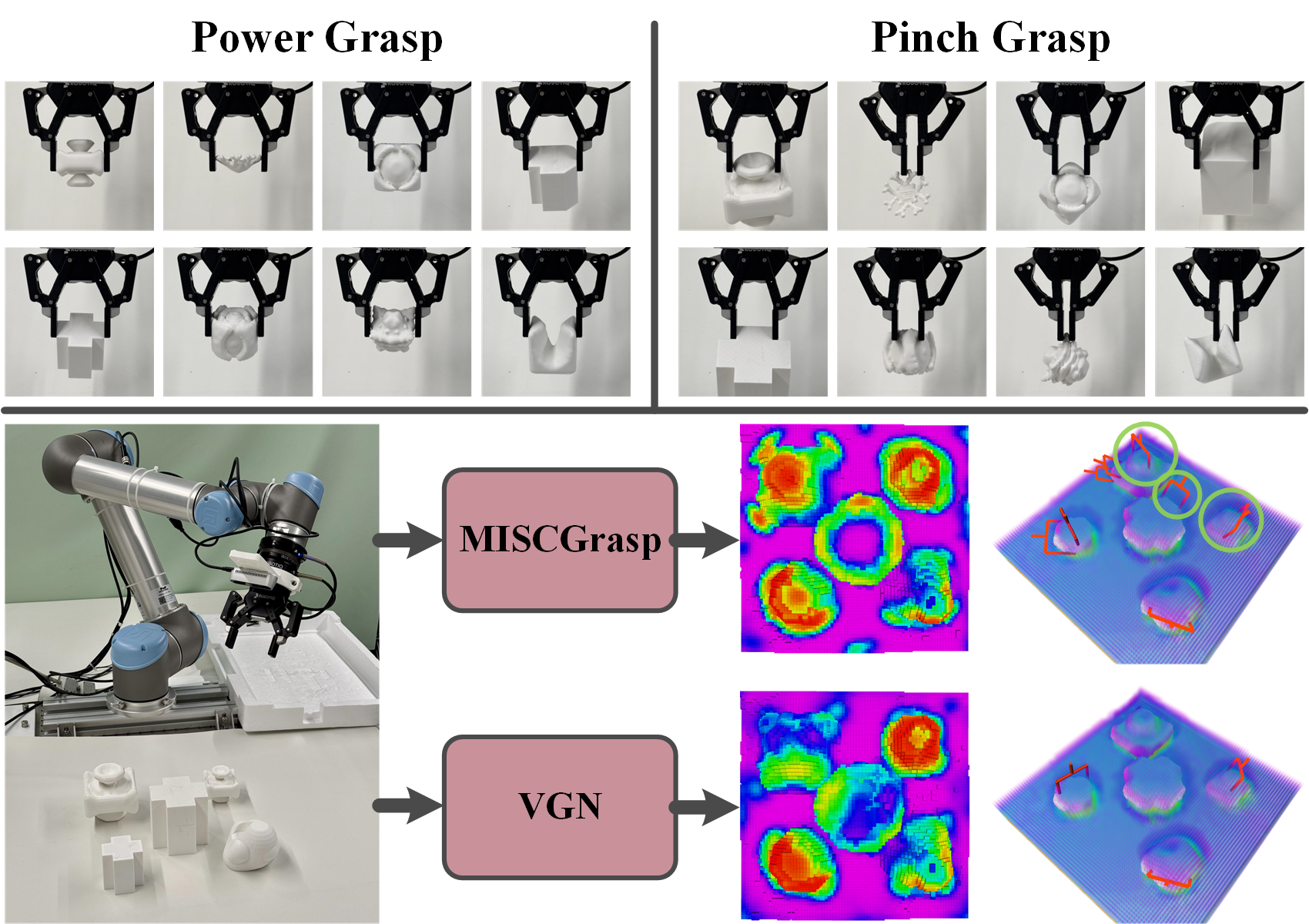
A parallel-jaw gripper can close around an object or pinch a narrow edge. MISCGrasp predicts both kinds of grasp from a 3D reconstruction of the scene.
From depth to grasp poses
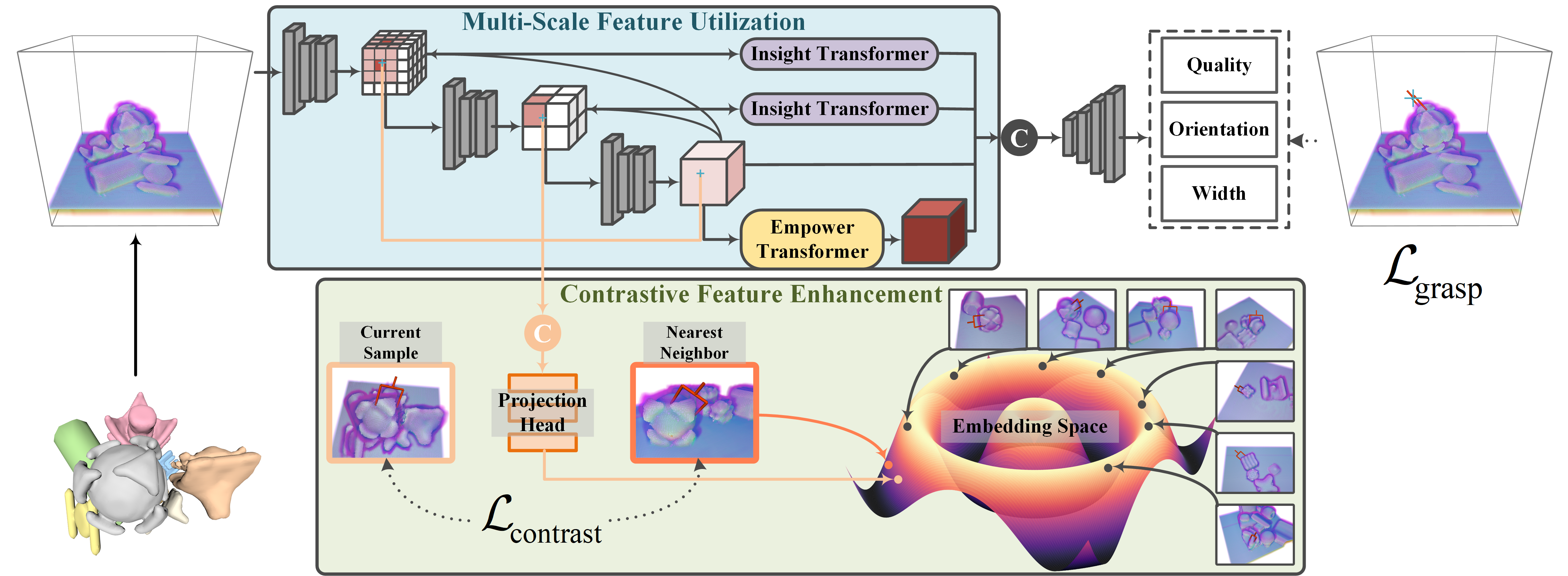
Depth images from several viewpoints are fused into a truncated signed distance field. At each voxel, the model predicts grasp quality, gripper orientation, and opening width.
The Insight Transformer uses coarse features to query fine-scale features for local geometry. The Empower Transformer refines the coarsest features, which encode the overall shape of the object.
During training, the model compares each successful grasp with nearby examples in a feature memory bank. The contrastive objective brings their representations closer across all three scales.
Paper abstract
Robotic grasping faces challenges in adapting to objects with varying shapes and sizes. In this paper, we introduce MISCGrasp, a volumetric grasping method that integrates multi-scale feature extraction with contrastive feature enhancement for self-adaptive grasping. We propose a query-based interaction between high-level and low-level features through the Insight Transformer, while the Empower Transformer selectively attends to the highest-level features, which synergistically strikes a balance between focusing on fine geometric details and overall geometric structures. Furthermore, MISCGrasp utilizes multi-scale contrastive learning to exploit similarities among positive grasp samples, ensuring consistency across multi-scale features. Extensive experiments in both simulated and real-world environments demonstrate that MISCGrasp outperforms baseline and variant methods in tabletop decluttering tasks.
Experiments
We evaluate 6-DoF grasps on individual objects and in clutter, both on a physical robot and in simulation.
On the robot
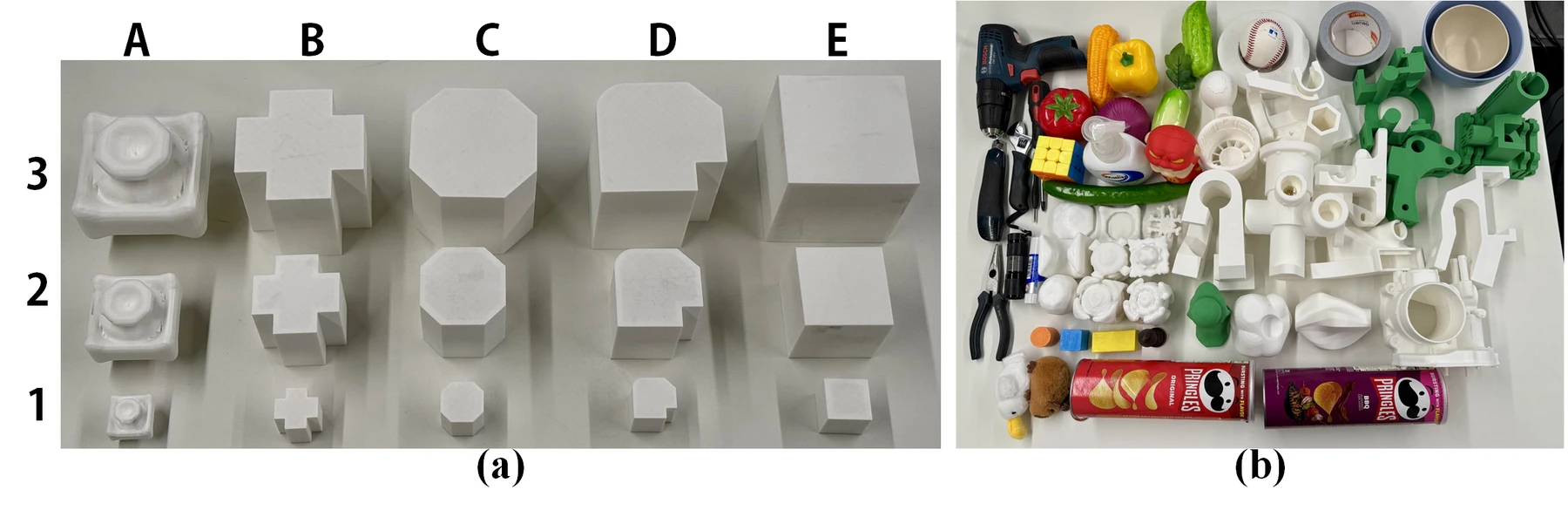
We use a UR5 arm, a Robotiq 2F-85 gripper, and a wrist-mounted Intel RealSense D435 in a 40 cm cubic workspace. We test five EGAD shapes, each printed at 3, 6, and 9 cm, to evaluate how the method handles changes in scale.
Each of the 20 clutter trials begins with ten objects drawn from a pool of EGAD shapes, Berkeley adversarial objects, and household items.
| Method | Grasp success | Objects cleared |
|---|---|---|
| MISCGrasp | 90.3% | 95.0% |
| VGN | 65.7% | 37.0% |
Grasp success is measured per attempt. The clearance rate is the fraction of the 200 objects removed across all rounds. Table IV in the paper
In simulation
EGAD-Single tests 147 objects individually. Each cluttered scene starts with ten objects, either piled or packed together. EGAD+ADV-Pile combines EGAD and Berkeley adversarial shapes to test pinch grasps in a pile.

Simulation trials
Full-length recordings
Grasping demonstrations
A UR5 lifts objects of different sizes. Simulation trials show how the gripper approaches objects in clutter.
Citation
@inproceedings{fan2025miscgrasp,
  title     = {{MISCGrasp}: Leveraging Multiple Integrated Scales and Contrastive Learning for Enhanced Volumetric Grasping},
  author    = {Fan, Qingyu and Cai, Yinghao and Li, Chao and Jiao, Chunting and Zheng, Xudong and Lu, Tao and Liang, Bin and Wang, Shuo},
  booktitle = {2025 IEEE/RSJ International Conference on Intelligent Robots and Systems (IROS)},
  year      = {2025},
  pages     = {11335--11342},
  doi       = {10.1109/IROS60139.2025.11246166}
}